
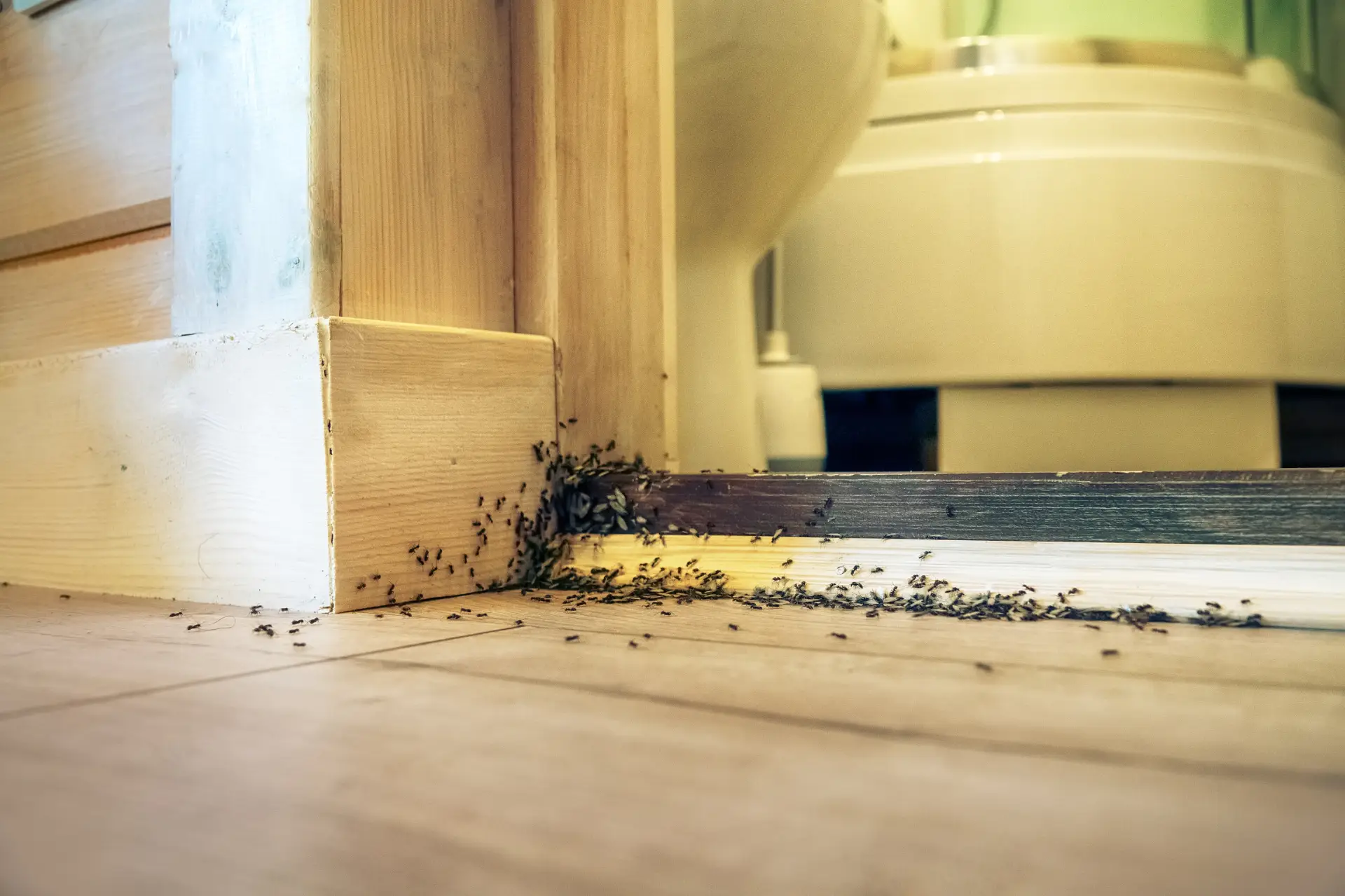
If you’ve ever walked into your kitchen and spotted a sudden trail of ants marching across the counter, you’ve probably wondered, “Why do ants keep coming into my house?”
Whether they’re searching for food, seeking moisture, or building satellite nests, ants enter homes for reasons tied closely to their biology and environment. Understanding why they come indoors is the key to stopping them and preventing future invasions.
This guide explains what attracts ants, how they behave, where they live, and what homeowners in Utah can do to permanently reduce ant activity.
I. Overview of Ants
Ants are among the most successful insects in the world, thriving in nearly every environment. Their ability to work cooperatively, communicate chemically, and adapt to changing conditions makes them persistent and difficult to eliminate without proper strategies.
Importance of Understanding Ant Behavior
Ants operate as a collective “superorganism.” What one ant does is only meaningful in relation to signals from the colony. This is why wiping away a few workers never solves infestations: the colony remains intact, constantly sending out new foragers. Understanding their motivations helps homeowners target the root problem, not just the symptoms.
II. Identifying Different Species of Ants
Common Types of Ants
Utah homeowners typically encounter species like odorous house ants, pavement ants, carpenter ants, and field ants. Each species behaves differently, nests in different environments, and reacts uniquely to treatment methods.
Characteristics and Traits of Different Ant Species
Odorous house ants emit a coconut-like smell when crushed and quickly form large multi-queen colonies. Pavement ants are typically found entering through cracks in concrete. Carpenter ants form satellite nests inside wood. Identifying the correct species helps determine whether the ants are attracted to sugar, protein, moisture, or nesting opportunities.
III. Understanding Ant Behavior and Communication
How Ants Communicate
Ants rely on pheromones, chemical scent trails that tell other ants where food is, where danger exists, and how to navigate. When you see a line of ants indoors, you’re witnessing an active pheromone highway. Disrupting that trail is only a temporary fix unless the colony itself is eliminated.
Social Structure Within Ant Colonies
Colonies are organized around the queen, who produces all offspring. Workers forage, feed larvae, defend the nest, and expand the colony. Some species have multiple queens, making them harder to control because killing one queen does not collapse the colony.
IV. Ant Habitats and Nesting Locations
Typical Ant Nesting Areas
Outdoors, ants nest in soil, under rocks, in logs, and around foundations. Indoors, they settle near moisture sources such as behind dishwashers, in wall voids near plumbing, inside insulation, or beneath floors. Many ants create satellite nests indoors while maintaining larger primary colonies outside.
Adaptations for Different Environments
Ants adapt remarkably well to human environments. Heated homes allow them to forage year-round, and plumbing lines act as moisture highways. Their ability to squeeze through cracks as small as 1/32 of an inch makes even well-sealed homes vulnerable.
V. Controlling Ant Infestations in Your Home
Signs of Ant Infestations
Common indicators include recurring trails, small piles of debris from nesting, winged swarmers, and nighttime ant activity around sinks or baseboards. Some signs, like rustling noises in walls, may point to species such as carpenter ants.
Effective Methods for Eliminating Ants
Elimination requires more than spraying visible ants. The most effective methods involve:
- Identifying species
- Targeting nests
- Using non-repellent products that ants carry back to the colony
- Addressing moisture problems
- Sealing entry points
True control occurs only when the queen—or multiple queens in multicolonial species—is eliminated.
VI. Natural Methods for Ant Population Control
Eco-Friendly Approaches to Ant Control
Many homeowners prefer natural methods such as vinegar solutions, essential oils, or dish soap mixtures. These approaches disrupt pheromone trails and repel ants temporarily, providing short-term relief without introducing harmful chemicals.
DIY Solutions to Reduce Ant Numbers
Homemade baits using sugar and borax can attract worker ants and impact small colonies. Diatomaceous earth can dry out ants when applied to their trails. While these methods help reduce activity, they are most effective when combined with professional guidance, especially for established infestations.
VII. Preventing Ants from Returning
Long-Term Strategies for Ant Prevention
Long-term prevention focuses on eliminating the factors that initially attracted ants. This includes sealing foundation cracks, storing food in airtight containers, repairing plumbing leaks, and trimming vegetation that touches the home.
Maintenance Tips to Keep Ants Away
Routine cleaning, wiping surfaces to remove pheromone residue, vacuuming crumbs, and addressing high-moisture zones significantly reduce the chance of ants returning. Seasonal pest control services ensure that perimeter treatments remain effective year-round.
VIII. Fascinating Facts About Ants
Ant Biology and Behavior
Ants navigate using a combination of pheromones, visual landmarks, and even the sun’s position. They also maintain caste systems that determine which ants forage, which defend, and which lay eggs.
Unique Characteristics of Ants
Ants can lift more than 20–50 times their body weight thanks to their muscular structure and lightweight exoskeleton. Their cooperative problem-solving abilities have inspired robotics, AI modeling, and scientific studies on complex systems.
IX. Importance of the Queen Ant in a Colony
Role of the Queen Ant
The queen keeps the colony alive by producing new workers. Without her, the colony collapses gradually. In species with multiple queens, eliminating every reproductive female becomes essential for long-term control.
Reproduction and Hierarchy in Ant Colonies
Ants follow a strict hierarchy: queens reproduce, workers support the colony, and males exist solely to mate. New colonies begin when queens leave the nest during swarming season and establish new sites after mating.
X. Strength and Abilities of Ants
Ants’ Remarkable Strength
Ants’ strength-to-weight ratio is legendary. Their exoskeletons distribute force efficiently, allowing incredible lifting abilities relative to size.
Physical Capabilities Relative to Size
Beyond strength, ants exhibit impressive navigation skills, coordinated group behavior, and instinctive engineering that allow them to construct complex tunnel systems even in harsh environments.
XI. Ants’ Role in the Ecosystem
Ecological Significance of Ants
Ants help aerate soil, disperse seeds, recycle nutrients, and maintain ecological balance. They also act as natural predators for pests.
Contribution to Environmental Balance
By breaking down organic matter and controlling insect populations, ants play an essential role in healthy ecosystems—even though they become a nuisance when they migrate indoors.
XII. So… Why Do You Get Ants in Your House?
Ants enter homes primarily for food, water, and shelter. Crumbs, spills, leaky pipes, warm environments, and easy access points all invite foraging workers. Once a trail is established, the colony will continue sending ants indoors until the food source is removed or the colony is eliminated.
Understanding these motivations helps homeowners create an environment that’s far less attractive to ants—and far easier to protect with professional pest control treatments.
Call Preventive Pest Utah for Expert Ant Control Services
Ants may seem small, but their colonies are sophisticated, persistent, and capable of causing ongoing problems once they settle in. Whether you’re dealing with odorous house ants, pavement ants, carpenter ants, or recurring seasonal invasions, Preventive Pest Utah can help eliminate the colony and prevent future activity with effective, long-term solutions.